

How to Use Screw-In Tent Pegs
If you’ve only used normal tent pegs, screw-in pegs can look a bit…extreme. More like something you’d see in a tradie’s toolbox or a rock climber's pack than a camping kit.
But use them once in hard ground, or during a storm, and you’ll be converted. Because unlike regular pegs, screw-in tent pegs don’t rely on good luck and smooth camping conditions to keep your shelter in place. They weave into the ground, grip, and stay firm in all weather and terrain.
If you haven’t yet given them a go, in this guide, we’ll run you through how to use screw-in tent pegs like a pro. We’ll cover the small stuff that people often get wrong early, and why screw-ins are worth having in your set-up. We’ll also take you through the best screw-in tent pegs to pack for different kinds of trips and terrain.
What exactly are screw-in tent pegs?
Screw-in tent pegs are basically a peg with a spiral thread. They’re constructed like a big outdoor screw with a steel, threaded shaft made to spiral into the earth with a drill or driver. Traditional tent pegs, on the other hand, are usually a smooth bit of metal, knocked into place with a mallet or pushed in with the heel of your shoe.
Design & mechanics
That thread, or “auger”, is the key point of difference.
A normal peg holds your shelter down using friction alone. A screw-in peg holds by grip, because the thread twists through the soil and resists any pull from different angles.
Tiegear’s Hard Terra also has a masonry-style tip for tough ground, so it can bore in cleaning while the thread anchors down.
Material matters
Not all screw-in pegs are created equal.
- Steel pegs suit hard ground conditions and high load points, especially for awnings and main guy lines. Tiegear’s Hard Terra is forged from 304 stainless steel.
- Reinforced nylon pegs are the best application for sand and soft soil. Tiegear’s Soft Terra uses UV-stabilised, engineering-grade reinforced nylon. It flexes instead of snapping when there’s movement in the terrain.
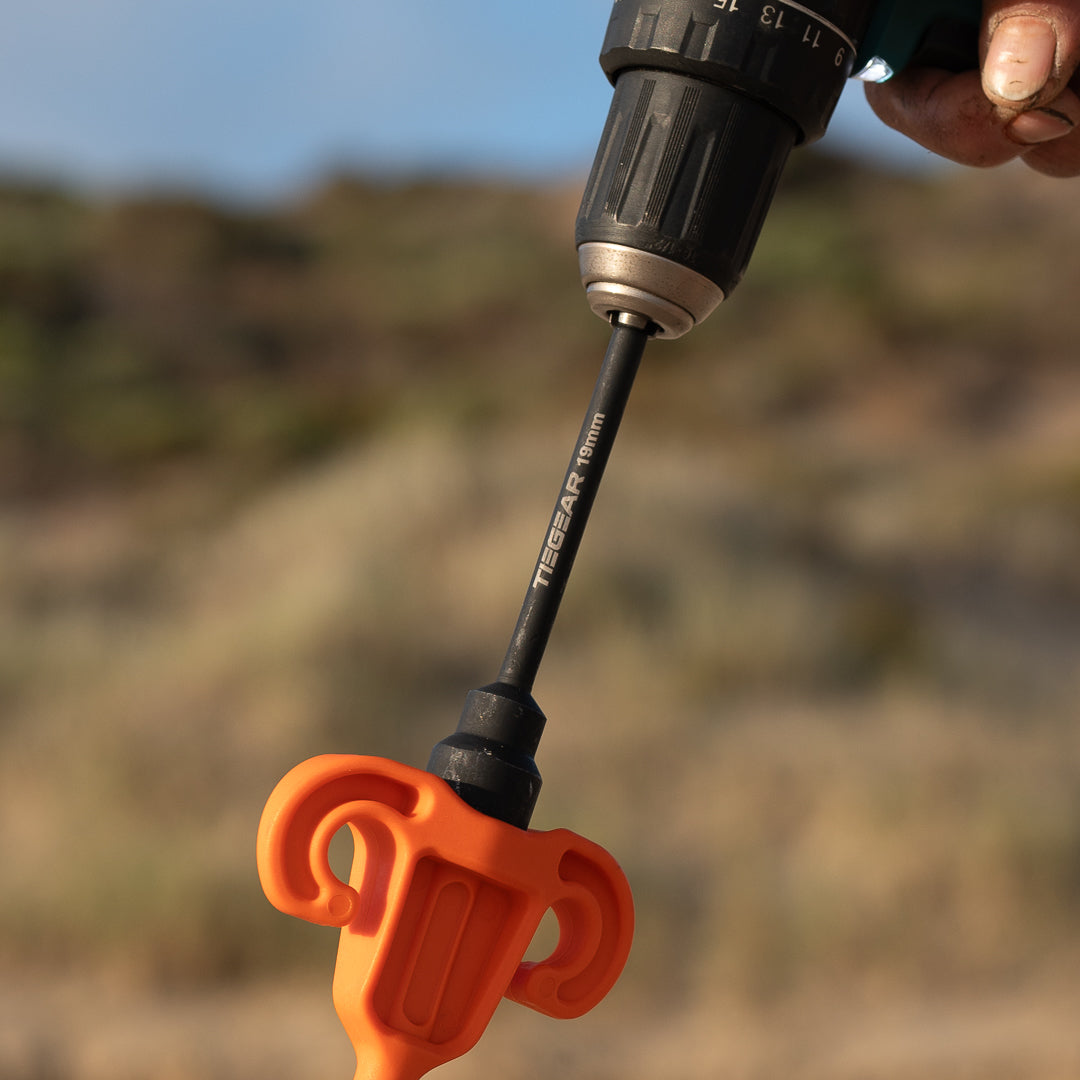
Hard Terra and Soft Terra screw-in pegs both run a 19mm socket head, which matches the stabiliser leg bolts on most caravans and campers. You won’t need to pack any extra equipment that you wouldn’t already have in your kit.
Why are Screw-In Pegs Better Than Traditional Tent Pegs?
Traditional pegs shouldn’t be made redundant just yet. They’re cheap, and they’re super lightweight. You can keep a handful as backups, and they’ll hardly impact your overall haul weight. But - screw-ins win as soon as conditions become anything but ideal.
Speed & efficiency
Pack a drill, and setup is soo much faster and easier. Packing down is simple, too, because you’re not yanking bent pegs out of rock-hard ground.
Unrivalled holding power
A peg threaded into the dirt is way harder to pull out than smooth metal is. When tension hits your guy rope, the threaded shaft gives the ground more to “grab”. With standard pegs, if the soil’s a bit loose or the guy rope pulls, the peg will just slide out.
Versatility across more terrain
Hard-packed clay, gravel sites, beach sand, soft riverbank soil… screw-in peg sets cover more bases.
Physical ease
Carrying a mallet is fine when you’re used to it, and it’s always the way you’ve done things. But with screw-in pegs, the drill (or impact driver) does all the work. Your back, thumbs, and energy levels will thank you later.
Step-by-Step: How to Use Screw-In Pegs
Step 1: The gear check
Before you start drilling, get your gear lined up.
You’ll need:
- Screw-in pegs suited to the ground (hard vs soft)
- A drill or impact driver with enough battery charge
- A 19mm socket, or your Tiegear Terra Driver (it’s designed to run with a drill)
-
Guy ropes, springs, or tiedowns
Step 2: Finding the angle
You may have worked to the “45 degrees away from the tent” rule your whole life. And you should stick with that when you’re using standard pegs. But screw-in pegs don’t always need it.
Most of the time, you can run screw-ins more upright than a normal peg because the thread is doing the heavy holding.
If the load is pulling sideways (like for an awning, or in heavier wind), angle the peg slightly away from the load so that it fights the pull rather than leans into it.
Quick Tips:
- Upright-ish for general tie-downs
- Slight angle away for bigger tension points like awnings
Step 3: Driving it home
Set your drill or driver to the logical torque setting. Start drilling slowly, and keep the pressure steady.
Stop when:
- The head of the peg sits firm and flat on the ground surface
- You’re not seeing the peg twist the ground around it
- The peg feels “locked” - give it a tug to check it’s holding tight
If you’re on very soft sand, you can overdo it. When that happens, the peg will just spin out and make the hole even bigger. We’ll cover that below.
Step 4: Managing the head and attaching ropes
This is where screw-in pegs feel superior in a lot of ways.
Tiegear’s Hard Terra pegs have a rotating double-hooked head, so you can line the hook up with the direction you need the rope to pull from.
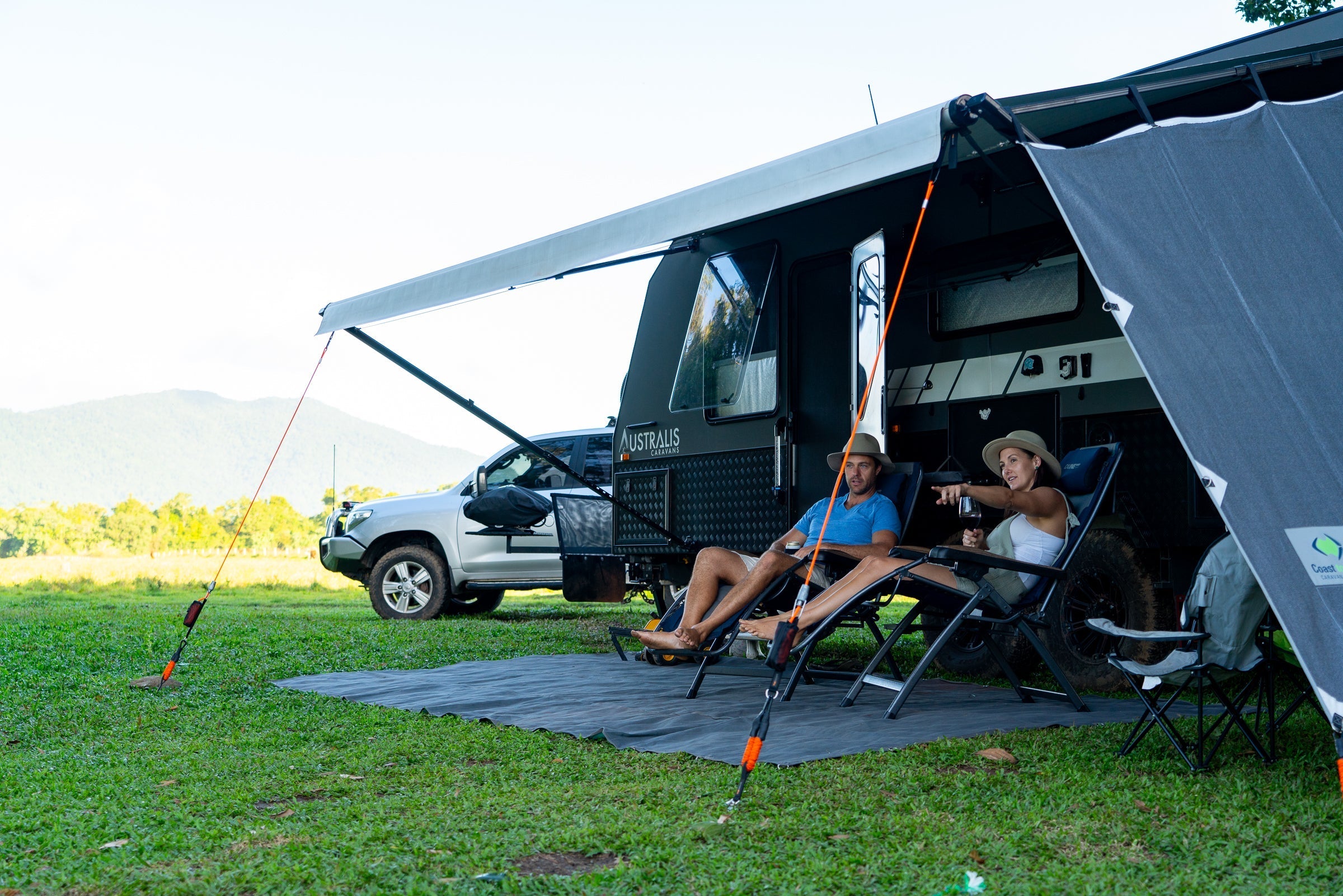
You can even run a few tie-downs in opposite directions off one peg, or clip your awning springs directly into the hook, then onto your guy ropes.
Pro tips for different ground types
Hard ground and rock
If you hit serious resistance when you’re drilling, whatever you do, don’t lean your whole bodyweight onto it and pray for the best. Instead, back it out a touch, change the angle slightly, and try again.
Hard Terra is purpose-made for the “hardest of terrain” with a masonry-style tip to really bore in. If you hit solid rock, move the peg 10–20cm and go again.
Sand and soft soil
Soft ground needs a different approach. Soft Terra pegs are designed for sand, snow, and soft soil, and they’re built to grip beyond the loose top layer.
In softer surfaces:
- Keep the angle lower for more hold
- Don’t overdrive it in powdery sand - that’s how you get “spin out”
- Set your guy ropes straight before you pull them for tension, so you’re not dragging the peg sideways
Cold or frozen ground
Pre-drilling with a 10mm bit can help you break through rock-solid frozen ground, allowing you to then drill your screw-in peg.
As opposed to regular pegs, screw-in tent pegs still give you a shot with this kind of environment, because you’re drilling into it, rather than hammering and bouncing off the surface.
Top Tips for Maintenance and Longevity
-
Clean the threads - A quick rinse and a wipe-down of your screw-in pegs, and all of your gear for that matter, will keep it in good order, for longer. Cleaning after every trip helps to stop grit from chewing things out over time.
-
Store them properly - Get a dedicated peg bag, and keep the driver you use for camping stored in the same spot every time. You’ll have faster access to your gear when you need it, and you’ll be less likely to lose any of it.
-
Follow the “when to stop” rule - If you feel the peg hit something solid and it suddenly tightens up hard, don’t just keep sending it. Back it out and reset, or move the peg to a different spot. Snapped heads and stripped threads usually come from being too stubborn with the driver.
Know how to use screw-in tent pegs, and get into the adventure faster
Once you learn how to use screw-in tent pegs, it will almost feel like you’re cheating. You’ll be setting up in record time and tackling unforgiving terrain, easy. Add awning springs, and even rough conditions will be no match for your camp.
Tiegear has a peg solution for every off-road environment. Whether you’re beach caravanning or tramping through rocky terrain, knowing how to use tent pegs efficiently for your camp will save you time and unwanted stress, so you can get to enjoying the great outdoors faster.
FAQs
Do I need a drill to use screw-in tent pegs?
No. But a drill makes it quick, and it saves your arms.
Tiegear screw-in pegs run a 19mm hex head, so you can use a 19mm socket in your drill, or a STEADFEST Terra driver made for it.
You can still use a hand tool if that’s what you’re packing; it just takes longer.
What angle should screw-in tent pegs go in at?
You don’t have to follow the classic 45-degree rule every time.
- Screw-ins can sit more upright because the thread “grips” the ground.
- For heavy or sideways loads, angle the peg slightly away from the direction of pull. Keep the rope line straight before you tension it.
- Which screw-in pegs should I use in sand?
Opt for the Soft Terra. It’s a sand-specific screw-in peg made from UV-stabilised reinforced nylon.
Here’s a quick guide to help you pack the right peg for the job:
|
Peg option |
Best for: |
|
Soft Terra |
Sand, snow, soft and loose soil |
|
Hard Terra |
Hard ground, clay, rocky sites, longer camp trips, heavy loads |
|
Light Terra |
Light shelters (swags, privacy screens), grass, weekend trips, as a backup |
|
Flat Terra |
Ground mats for both hard and soft surfaces |
|
Traditional pegs |
Calm weather, light setups |

Leave a comment
This site is protected by hCaptcha and the hCaptcha Privacy Policy and Terms of Service apply.